"Using Black Elk's dialog, Neihardt offers the reader insight into the ritualistic spirituality of the Lakota culture and how this spirituality influenced their response to internal conflict with other tribes and the American soldiers.".Our claim took most of class time to construct and even then we were not completely satisfied. The construction of a thesis statement continues to be my greatest challenge. I hope to continue Black Elk with this statement in mind, as well as Black Elk's vision an mysticism.
Saturday, April 30, 2011
More Black Elk, arguing a claim and sentence structure.
During class on Friday, my group examined Black Elk Speaks through religious tones and the effects of westward expansion. By the end, we came up with the following:

The beginning of Black Elk Speaks
John G. Neihardt wrote Black Elk Speaks to share the story of Black Elk, a member of the Lakota tribe he met on the Pine Ridge Reservation in South Dakota. Neihardt's source for the work is interviews with Black Elk himself, the translation of Black Elk's son Benjamin, and the shorthand recording of Neihardt's daughter Enid. The narrative is written in first person, as if Black Elk himself is speaking to the reader, and it is clear that Neihardt took some liberties with the writing (but that is another matter entirely).
Within the first portion of the work, it is clear that Black Elk's vision is the heart of the work. Black Elk's experience includes a tale full of imagery of his forefathers, setting Black Elk apart as a leader of his people. Because Black Elk lived through the procession of westward expanded, he experienced the painful process of being expanded upon. As a result, we as readers experience the tragic loss of the Lakota people through the lens of Black Elk and his fantastic vision.
From my experience thus far, it has been difficult to not be bogged down by the details and technicalities of the work. In response, I plan to focus primarily on Black Elk's vision and its contrast to historical reality.
Within the first portion of the work, it is clear that Black Elk's vision is the heart of the work. Black Elk's experience includes a tale full of imagery of his forefathers, setting Black Elk apart as a leader of his people. Because Black Elk lived through the procession of westward expanded, he experienced the painful process of being expanded upon. As a result, we as readers experience the tragic loss of the Lakota people through the lens of Black Elk and his fantastic vision.
From my experience thus far, it has been difficult to not be bogged down by the details and technicalities of the work. In response, I plan to focus primarily on Black Elk's vision and its contrast to historical reality.
Reflections on Easter Break (I miss rural Wisconsin)
 |
| Sunset outside my grandparents' home in Chaseburg, WI. |
 |
| View of the adjacent Amish homestead. |
While this post may not be the most pertinent in content, this past break had me reflecting a lot on the transcendentalist works. I may not have gotten all the work I wanted done over break, I was able to step back and have time to think. I think Thoreau would have been proud of me.
Tuesday, April 19, 2011
Mohn Hall and social capital

"One of the two towers on campus, Mohn is a ten-story residence hall housing 307 students. The hall, which traditionally houses first-year and sophomore students by floor, offers a main lounge, a recreational room, and a piano room. The circular arrangement of each corridor creates a strong community atmosphere."
- Excerpt from the St. Olaf website
Well, the roomdraw results are in... and I'll be a resident of Mohn hall next year! To my knowledge, the majority of students housed within the building will be sophomores (which will be great!). However, because everyone in AmCon was purposely housed in Hoyme, I'll be curious to see how differences in our living arrangements will affect AmCon. It won't be as easy as just going to the Hoyme lounge to work on a project or walking down the hall to ask a classmate a question about the homework. We'll probably have to walk across campus to meet--the horror!
A lot of my friends, myself included, are nervous as to how new living arrangements will affect relationships. Are we really so simple that our friendships are determined by proximity? It's something to think about, but only time will tell.
Either way, I'm excited for sophmore year and year two of American Conversations!
As Long as Grass Grows or Water Runs: Indian Removal and Jacksonian Imperialism
"Say to the chiefs and warriors that I am their friend, that I wish to act as their friend but they must, by removing from the limits of the State of Mississippi and Alabama and by being settled on the lands I offer them, put it in my power to be such--There, beyond the limits of any State in possession of land of their own, which they shall possess as long as Grass grows or water runs. I am and will protect them and be their friend and father." --Zinn, 133-4
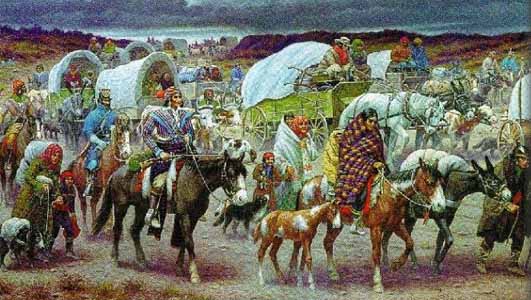 | ||
| Painting depicting the "Trail of Tears"--the forced migration of the Cherokee people. |
This begs the question.. How could we? I believe the answer lies in the social turn that began with the shift from an agrigarian to industrial society. The railroads closed distances and provided quick routes for business, but it also began a sense of isolation and self-interest. With the rails came big business, and sparked the spirit of capitalism. With capitalism, selfishness and a survival of the fittest attitude became virtues and hallmarks of success. This culture was so diametrically opposite than that of Native American cultures, from there it is easy to see how capitalism could exploit them for the sake of profit.
I don't mean to say that capitalism is always a source of evil. Because of our study of trains, the railroad and the beginnings of the industrial revolution, I've analyzed this through that lens. I would like to know if any of my other classmates have made this connection.
Tuesday, April 12, 2011
Individualism and civil disobedience
"When many millions of men, without heat, without ill-will, without personal feeling of any kind, demand of you a few shillings only, without the possibility, such is their constitution, of retracting or altering their present demand, and without the possibility, on your side, of appeal to any other millions, why expose yourself to this overwhelming brute force?" - Henry David Thoreau, "Civil Disobedience" (page 15)Above all else, Henry David Thoreau calls for the empowerment of citizens and the rise of individualism in his essay "Civil Disobedience". With this idea, he defines a "good" citizen as someone who goes beyond the act of voting. To become a truly engaged citizen, Thoreau advises people to "cast your whole vote, not a strip of paper merely, but your whole influence." (9).
Henry David Thoreau's opinion on individualism was certainly not a popular idea at the time. If Alexis de Tocqueville was introduced to Thoreau's essay "Civil Disobedience" he would further express his fear over dangers of equality and individualism. Tocqueville and others like him would pronounce Thoreau's ideas as radical and dangerous.
While Thoreau wrote his essay on disobedience, he does not break all laws. Rather, he only submits to laws for good reasons and to those he describes as "who know and can do better than I" (18). Thoreau suggests a conversation about the room for improvement in the American system of Democracy. However, he also warns that Democracy must move more towards individualism above all else.
Sunday, April 10, 2011
Thoreau, registration, and roomdraw
 | |
| A "comforting" message that I found posted by a library printer. |
"...millions are awake enough for physical labor; but only one in a million is awake enough for effective intellectual exertion, only one in a hundred million to a poetic or divine life." (59)It's funny for a reading like this one to arise at possibly the most stressful week of the academic year. Along with registration, roomdraw, and "dense" academic work--the long haul until finals. Now more than ever I'm aware that I have a bad habit of falling into a routine. For example, I sometimes check out on the way to class, and I'll pass by a friend and simply not see them at all because I was too occupied by my busy schedule.
If Thoreau and I were to meet, he would probably describe me as a "sleeper". A sleeper being someone so caught up in the details and so focused that they cannot step back and see the big picture. Thoreau believed in living simply, and that is why he chose to live in a farmhouse apart from civilization.
I try to justify my nature by the goals I wish to acheive. I want to be an English and Education major, while also finding time to become certified to teach ESL (english as a second language). I made a four year plan today, and I've realized that I may be in over my head. A meeting with the registrar tomorrow will determine whether or not I can continue in American Conversations. I'm trying to keep Thoreau in mind, but for now all I can do is try to keep calm and carry on.
Subscribe to:
Posts (Atom)