Sunday, April 10, 2011

Thoreau, registration, and roomdraw

A "comforting" message that I found posted by a library printer.

"...millions are awake enough for physical labor; but only one in a million is awake enough for effective intellectual exertion, only one in a hundred million to a poetic or divine life." (59)
It's funny for a reading like this one to arise at possibly the most stressful week of the academic year.  Along with registration, roomdraw, and "dense" academic work--the long haul until finals.  Now more than ever I'm aware that I have a bad habit of falling into a routine.  For example, I sometimes check out on the way to class, and I'll pass by a friend and simply not see them at all because I was too occupied by my busy schedule.

If Thoreau and I were to meet, he would probably describe me as a "sleeper".  A sleeper being someone so caught up in the details and so focused that they cannot step back and see the big picture.  Thoreau believed in living simply, and that is why he chose to live in a farmhouse apart from civilization. 

I try to justify my nature by the goals I wish to acheive.  I want to be an English and Education major, while also finding time to become certified to teach ESL (english as a second language).  I made a four year plan today, and I've realized that I may be in over my head.  A meeting with the registrar tomorrow will determine whether or not I can continue in American Conversations.  I'm trying to keep Thoreau in mind, but for now all I can do is try to keep calm and carry on.

Admitted students day (and hosting two prospies)

This weekend was admitted students day for the class of 2015, and I served as an overnight host for two prospective students.  One from Stillwater, MN and another from Kansas.  When I mentioned that I am a part of American Conversations, they had a lot of questions and it was hard to explain exactly what we have done for almost two semesters.  I showed them my blog along with DeAnne's, but that wasn't enough.  In short, I said that it was a discussion-based exploration of Democracy from the start of American history up until the present.  Above all else, I tried to express my love of the program and subject matter without resorting to typical admissions cliches.  I guess I'm still in the process of understanding American Conversations.

Emerson on a beautiful Friday afternoon

I was incredibly grateful to have an opportunity to revisit Emerson after class on Friday.  I sat on a bench near the grand looking door on the side of the library and cherished the delightfully warm spring breeze.  Although I've read, and reread Emerson's "Nature", I would be lying if I claimed to understand all of what he said.  Emerson's prose is beautiful, so much so that it like a spring breeze it lulls me into a daze.  Sentences meander off and I can't quite pin down the thought behind his arguement. 

From what I understand, Emerson believes that nature reflects the intentional plan of a creator.  Emerson seeks to solve the "big" or "unanswerable" questions through his observations on nature.  In the process, he defines nature, as "essences unchanged by man; space, the air, the river, the leaf" (2).  The beauty he observed he also attributed it to the presence of God and his plan. 

If Emerson and I were to have a conversation, we would surely disagree.  For one, I could not follow the circular notion of God, perfect order in nature, nature as an interpreter of the notion of a soul/spirit.  While we may not agree, I appreciated the exercise of working through "Nature".

Tuesday, April 5, 2011

Nathaniel Hawthorne's neutrality and use of railroads as a literary device

Painting of Nathaniel Hawthorne.
I focused on Nathaniel Hawthorne from the article "The Transcendental Railroad" by G. Ferris Cronkhite.  While all three authors (Emerson, Thoreau and Hawthorn) regard the railroad as significant and an inspiration to their work, Hawthorn is unique because he "completely subdued the railroad to the literary task at hand" (347).  Throughout all of Nathaniel Hawthorne's writing, he focuses and the symbolism and imagery provided by the railroads.

While Hawthorne was neutral on the subject of railroads, he had a clear opinion on pilgrimages.  Hawthorne believed that if their were pilgrimages in America, they would probably take place via stagecoach or rail car.  These pilgrims would have "earthly cares" instead of the "heavenly meditations" gained by traveling on foot through the countryside.  

Nathaniel Hawthorne contrasts these two different categories of pilgrimages in "The Celestial Railroad".  This work satirizes transcendentalism and the new liberal theology of Unitarians (which disregarded the Calvanistic idea of sin and instead proposed universal salvation).  Christian, a character in the story, gains heavenly meditations by traveling on foot.  However, his sufferings are glossed over to focus on a train ride of the narrator to Celestial City.  On this train ride, passengers disregard their concerns and baggage to subjects of Beezlebub which attend to baggage, fuel and firebox of the train.  Through suggestions of ominous imagery, it is revealed at the end that the true destination of the train is not Celestial City but to the River of Death and onward to Hell itself.

While the article "The Transcendental Railroad" regards Nathanial Hawthorn as neutral, I believe that he is also concerned with railroads as a symptom of man's materialistic interests and values.  Although "The Celestial Railroad" is a work of satire, it expresses Hawthorne's opinion on salvation, that a true pilgrim must gain "heavenly inspirations" impossible to obtain by traveling in a train car.  

Sunday, April 3, 2011

The American railroad as an example of change

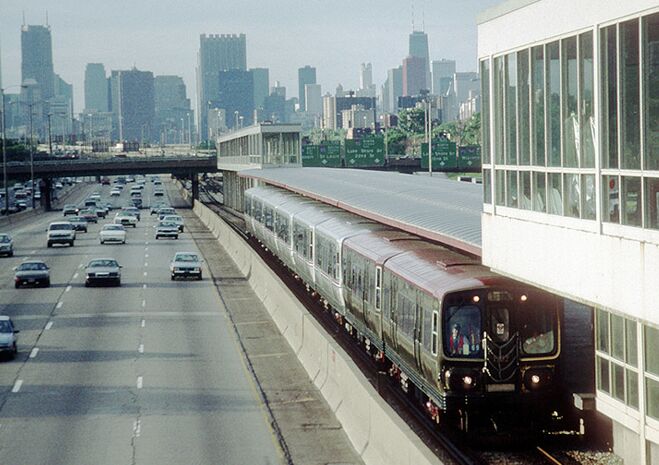
An example of the rail system in Chicago.
As a Chicago suburbanite, I've always considered the rail roads as something tha has always been a part of the United States.  Despite my naivete, the introduction of the locomotive had a monumental impact on 19th century america.  The locomotive serves as a symbol for the 19th century followed by the change that swept through the American infrasturtuce, economy, and public sentiment. 

To start, the faster transportation provided by trains allowed for industrialization.  With the routinized shipment of goods, materials and people new markets were open as well as new methods for business.  During the peak, all business had a vested interest in the railroads and all cities and towns vied to have a place on the rail ines because it was the difference between disappearance and prosperity. 

Industrial business embodied a shift from small scale local operations to huge, national companies.  For example, in the begninnings of railroad construction there were a multitude of small companies working on small sections.  Then, companies began to snowball growing larger and swallowing up small companies to eliminate competition.  this gave rise to the infamous monoploies leading to public demand for government regulation and the beginnings of labor unions.  The perception of the American people also shifted from a local to a more national level.  However, not all responses to the increasing presence of rail roads was positive.  Many saw the change as destruction of order, and many farmers were experiencing the painful economic shift from agriculture to industry. 

Rail roads in the early 19th century are only one example of events that changed the lives and perceptions of Americans.  The same analysis can be applied to the internet and the dot com boom that spanned the late nineties to early 2000's.  I believe that the most pertinent example at present is social media as a means of cultivating previously untapped social capital.  As we continue to  explore democracy and the importance of voluntary associations it is important to keep events within their historical context.  While railroads may not be as exciting today as they were in the early 19th century, change will eventually out date social media such as facebook.

Second Semester Co-Curricular Fair

This past Thursday I tabled for the St. Olaf Unitarian Universalists.  I helped make a sign, and we put out candy to "attract" people to our display.  I found it fascinating to see people "come out of the woordwork" to represent their organizations.  Although we're able to list our interests on facebook and blog about our passions, I beleive that student engagement at St. Olaf is so obvious as it is at co-curricular fairs.  There is a  huge difference between reading a list of the student organizations on the St. Olaf website and seeing actual representatives of the organization. 

While the event was not as large as the co-curricular fair held at the beginning of the school year, it served as a reminder of student engagement at St. Olaf. 

Tuesday, March 29, 2011

The Hudson River School: Nature and American character

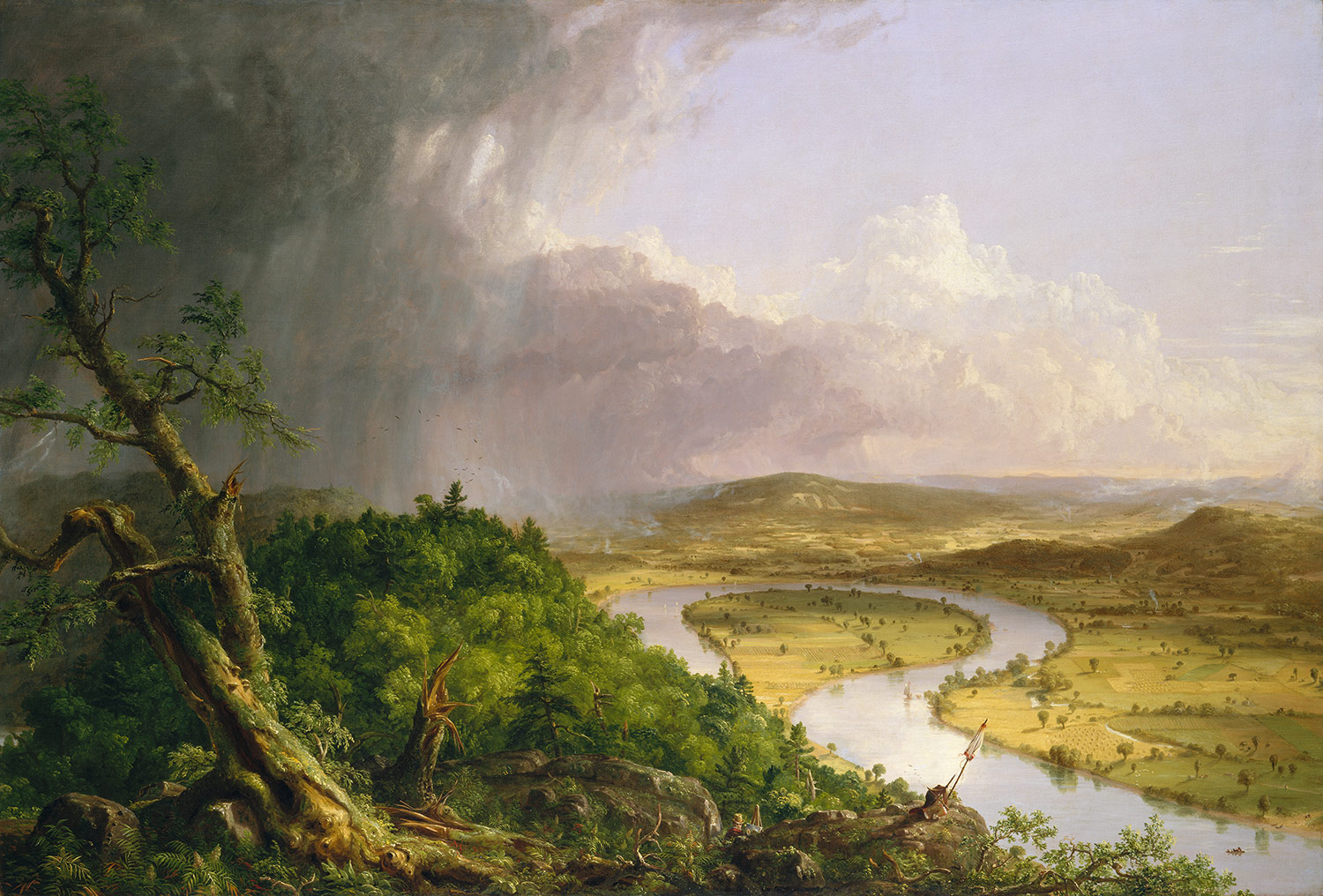
Thomas Cole's "Oxbow"
The Hudson River School represented the relationship between the vast wilderness of the American continent and man.  The artists affiliated with the school believed that art was an agent of moral and spiritual transformation.  In painting's such as Thomas Cole's "Oxbow" the painting served as a vehicle through which the "universal mind could reach the mind of mankind".  In short, the relationship between God and man through nature. 


The "sublime" image in "Oxbow" is the massive, captivating scene from Mount Holyoke to the farmland below.  On the left, the approaching storm clouds embody and almost omnipotent perspective.  The right represents the world of man, the "better" side because it is more peaceful and familiar to the audience.  The broken tree stump in the foreground represents a connection between the two halves.  Cole called it "memento mori" or reminder that life is not permanent and that only Nature and the Divine are eternal.  It was through pieces such as "Oxbow" that Thomas Cole illustrated his belief in the connection between beauty and good.  Cole believed that the beautiful landscapes of America represented the opportunity the country had.

Alexis de Tocqueville expressed views opposite of Thomas Cole in Democracy in America.  Tocqueville believed that natural landscape did not/would not play an important role in the American cultural consciousness and other forces such as religion and the legal system would play a larger role.  Tocqueville also believed that American's were more concerned with subduing nature tahtn perserving it, that the focus was more geared towards technology and expansion rather than conservation.

The opposing viewpoint of Cole and Tocqueville represent the continuous debate over American attitudes towards nature.  The jury is still out concerning whether or not American society values its unique landscapes.  On one hand, America has a multitude of national parks and works towards conservation.  On the other hand, American capitalism has quickly consumed many natural landscapes and our increasingly polluted environment is evidence of indifference. 

So, if we side with pessimism Tocqueville once again serves as a forecast of America's future.  I'm curious as to what my classmates will think.  Which is more correct, Cole's idealistic view or Tocqueville's prediction of neglect towards nature?