Sunday, September 11, 2011
First Post of the School Year
It's "first post" time! I'm very excited for the next installment of American Conversations. It's a little strange that we're all scattered across campus now and getting help with readings will be a little more involved than going a few doors down. I am grateful to have another year with my classmates regardless. Just like last year, I commit to making three substantive posts a week and more as I have insights relevant to American Conversations.

Monday, May 16, 2011
Last Day of AmCon 102
 | |
| A "word cloud" I made of my blog. |
On a different note, I found the in class quote review to be helpful. I found more connections that I could use in my final paper, as well as just having a clearer context for themes of the semester. We've really covered a lot of ground this semester, and I look forward to using what I've learned next semester in Amcon 201!
Sunday, May 15, 2011
Concise writing concerning Democracy
I've done quite a bit of work on my final essay, and the following are quotes that I'm using to make my argument. However, they are also relevant beyond my paper because they embody the components and themes of Democracy that we have discussed this semester.
- "On the contrary, I am persuaded that in the case the collective force of citizens will always be better able to achieve social prosperity than the authority of the government." Democracy in America, Pg. 91.
- "If we do not get out sleepers, and forge rails, and devote days and nights to the work, but go on tinkering upon our lives to improve them, who will build railroads? And if railroads are not built, how shall we get to heaven in season? But if we stay at home and mind our business, who will want railroads? We do not ride on the railroad; it rides upon us." Walden, "Where I Lived, and What I Lived For", Pg. 60.
- "And like other American Dreams, the power in this one lay in a sense of collective ownership: anyone can get ahead." The American Dream, "Dream of a the Good Life (II): Upward Mobility", Pg. 60.
- "Social scientists in several fields have recently suggested a common framework for understanding these phenomena, a framework that rests on the concept of social capital.--By analogy with notions of physical capital and human capital--tools and training that enhance individual productivity--"social capital" refers to the features of social organization such as networks, norms, and social trust that facilitate coordination and cooperation for mutual benefit." "Bowling Alone: America's Declining Social Capital".
A New Threat to Democracy: "Beware Online Filter Bubbles"
While browsing through TED talks, I couldn't help but notice the following video and its relevance to our ongoing conversation on responsibilities of a citizen. In the video, Eli Parjser identifies a new blockade of information: invisible filtering of content. As social media outlets such as Facebook have worked to become more profitable by data-mining and monitoring user interests, what shows up in one's newsfeed is now tailored by algorithims. While this may aid in convenience by cutting down on unwanted content it also narrows our scope of the world.
For example, there is now no longer any standard google search. This is dangerous because as of now it is not clear to citizens how content is being filtered--many are not aware that it is happening at all. If we allow our content to be filtered according just to our interests, we can inadvertently become isolated and more ignorant.
Tuesday, May 10, 2011
NOW presentation & reflections
Our group of five analyzed the National Organization for Women for part three of our ongoing analysis of democracy in America. While at the beginning, our group only had a vague understanding of women's associations, by the end we had all become knowledgeable resources about the subject ourselves. The project truly was a group effort, and I observed no unequal distribution of the work. The most difficult part of the presentation was just deciding how we were going to present the mountain of information we collectively gathered on the organization. I am happy to report that our group presentation of NOW has been a positive and well worthwhile experience of the semester concerning our ongoing conversation on Democracy.
While our content was serious, our pageant-style presentation was intentionally ironic. I had a good time with this, and I hope my classmates enjoyed our presentation!
Sunday, May 1, 2011
Osama Bin Laden, personal reflections, and beaded flag pins.
I am not the first, nor will I be the last to reiterate the news: Osama Bin Laden is dead. While diligently studying for a biology exam, I took a quick facebook break only to discover the monumental news. I went on to watch the live news feed on MSNBC and await president Obama's speech for over an hour. Albeit a distraction, I am grateful to social media for alerting me to the event and enabling me to watch the news unfold.
As American Conversations is an ongoing analysis of democracy along the course of American history, an event such as this is of utmost importance. Looking back on 9/11, the tragedy was coupled an enormous sense of patriotism. For example, I remember that all the craft stores wtihin my town had run out of red, white and blue bead. Everyone I knew had made an American flag bead pin. While small, the American flag pin is my "dense fact" for American patriotism and 9/11.
Many news correspondents had alluded to the surge in patriotism following 9/11, posing the question Will America be united once again? Or, in consideration of Tocqueville, will this event help America overcome the threat of individualism and allow for greater democracy?
I know that there are presentations in class tomorrow, but I am curious to know what my classmates think of the news. I for one wish that I had some red, white, and blue beads to make a flag pin and more time to reflect on the matter.
 |
| A flag pin constructed of beads. |
Many news correspondents had alluded to the surge in patriotism following 9/11, posing the question Will America be united once again? Or, in consideration of Tocqueville, will this event help America overcome the threat of individualism and allow for greater democracy?
I know that there are presentations in class tomorrow, but I am curious to know what my classmates think of the news. I for one wish that I had some red, white, and blue beads to make a flag pin and more time to reflect on the matter.
Saturday, April 30, 2011
More Black Elk, arguing a claim and sentence structure.
During class on Friday, my group examined Black Elk Speaks through religious tones and the effects of westward expansion. By the end, we came up with the following:
"Using Black Elk's dialog, Neihardt offers the reader insight into the ritualistic spirituality of the Lakota culture and how this spirituality influenced their response to internal conflict with other tribes and the American soldiers.".Our claim took most of class time to construct and even then we were not completely satisfied. The construction of a thesis statement continues to be my greatest challenge. I hope to continue Black Elk with this statement in mind, as well as Black Elk's vision an mysticism.
The beginning of Black Elk Speaks
John G. Neihardt wrote Black Elk Speaks to share the story of Black Elk, a member of the Lakota tribe he met on the Pine Ridge Reservation in South Dakota. Neihardt's source for the work is interviews with Black Elk himself, the translation of Black Elk's son Benjamin, and the shorthand recording of Neihardt's daughter Enid. The narrative is written in first person, as if Black Elk himself is speaking to the reader, and it is clear that Neihardt took some liberties with the writing (but that is another matter entirely).
Within the first portion of the work, it is clear that Black Elk's vision is the heart of the work. Black Elk's experience includes a tale full of imagery of his forefathers, setting Black Elk apart as a leader of his people. Because Black Elk lived through the procession of westward expanded, he experienced the painful process of being expanded upon. As a result, we as readers experience the tragic loss of the Lakota people through the lens of Black Elk and his fantastic vision.
From my experience thus far, it has been difficult to not be bogged down by the details and technicalities of the work. In response, I plan to focus primarily on Black Elk's vision and its contrast to historical reality.
Within the first portion of the work, it is clear that Black Elk's vision is the heart of the work. Black Elk's experience includes a tale full of imagery of his forefathers, setting Black Elk apart as a leader of his people. Because Black Elk lived through the procession of westward expanded, he experienced the painful process of being expanded upon. As a result, we as readers experience the tragic loss of the Lakota people through the lens of Black Elk and his fantastic vision.
From my experience thus far, it has been difficult to not be bogged down by the details and technicalities of the work. In response, I plan to focus primarily on Black Elk's vision and its contrast to historical reality.
Reflections on Easter Break (I miss rural Wisconsin)
 |
| Sunset outside my grandparents' home in Chaseburg, WI. |
 |
| View of the adjacent Amish homestead. |
While this post may not be the most pertinent in content, this past break had me reflecting a lot on the transcendentalist works. I may not have gotten all the work I wanted done over break, I was able to step back and have time to think. I think Thoreau would have been proud of me.
Tuesday, April 19, 2011
Mohn Hall and social capital

"One of the two towers on campus, Mohn is a ten-story residence hall housing 307 students. The hall, which traditionally houses first-year and sophomore students by floor, offers a main lounge, a recreational room, and a piano room. The circular arrangement of each corridor creates a strong community atmosphere."
- Excerpt from the St. Olaf website
Well, the roomdraw results are in... and I'll be a resident of Mohn hall next year! To my knowledge, the majority of students housed within the building will be sophomores (which will be great!). However, because everyone in AmCon was purposely housed in Hoyme, I'll be curious to see how differences in our living arrangements will affect AmCon. It won't be as easy as just going to the Hoyme lounge to work on a project or walking down the hall to ask a classmate a question about the homework. We'll probably have to walk across campus to meet--the horror!
A lot of my friends, myself included, are nervous as to how new living arrangements will affect relationships. Are we really so simple that our friendships are determined by proximity? It's something to think about, but only time will tell.
Either way, I'm excited for sophmore year and year two of American Conversations!
As Long as Grass Grows or Water Runs: Indian Removal and Jacksonian Imperialism
"Say to the chiefs and warriors that I am their friend, that I wish to act as their friend but they must, by removing from the limits of the State of Mississippi and Alabama and by being settled on the lands I offer them, put it in my power to be such--There, beyond the limits of any State in possession of land of their own, which they shall possess as long as Grass grows or water runs. I am and will protect them and be their friend and father." --Zinn, 133-4
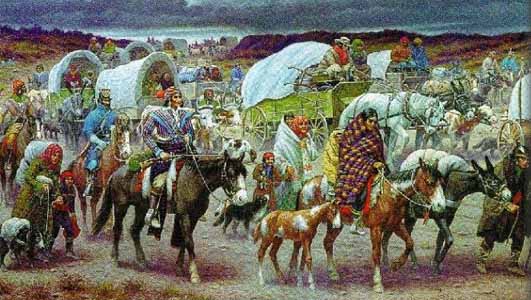 | ||
| Painting depicting the "Trail of Tears"--the forced migration of the Cherokee people. |
This begs the question.. How could we? I believe the answer lies in the social turn that began with the shift from an agrigarian to industrial society. The railroads closed distances and provided quick routes for business, but it also began a sense of isolation and self-interest. With the rails came big business, and sparked the spirit of capitalism. With capitalism, selfishness and a survival of the fittest attitude became virtues and hallmarks of success. This culture was so diametrically opposite than that of Native American cultures, from there it is easy to see how capitalism could exploit them for the sake of profit.
I don't mean to say that capitalism is always a source of evil. Because of our study of trains, the railroad and the beginnings of the industrial revolution, I've analyzed this through that lens. I would like to know if any of my other classmates have made this connection.
Tuesday, April 12, 2011
Individualism and civil disobedience
"When many millions of men, without heat, without ill-will, without personal feeling of any kind, demand of you a few shillings only, without the possibility, such is their constitution, of retracting or altering their present demand, and without the possibility, on your side, of appeal to any other millions, why expose yourself to this overwhelming brute force?" - Henry David Thoreau, "Civil Disobedience" (page 15)Above all else, Henry David Thoreau calls for the empowerment of citizens and the rise of individualism in his essay "Civil Disobedience". With this idea, he defines a "good" citizen as someone who goes beyond the act of voting. To become a truly engaged citizen, Thoreau advises people to "cast your whole vote, not a strip of paper merely, but your whole influence." (9).
Henry David Thoreau's opinion on individualism was certainly not a popular idea at the time. If Alexis de Tocqueville was introduced to Thoreau's essay "Civil Disobedience" he would further express his fear over dangers of equality and individualism. Tocqueville and others like him would pronounce Thoreau's ideas as radical and dangerous.
While Thoreau wrote his essay on disobedience, he does not break all laws. Rather, he only submits to laws for good reasons and to those he describes as "who know and can do better than I" (18). Thoreau suggests a conversation about the room for improvement in the American system of Democracy. However, he also warns that Democracy must move more towards individualism above all else.
Sunday, April 10, 2011
Thoreau, registration, and roomdraw
 | |
| A "comforting" message that I found posted by a library printer. |
"...millions are awake enough for physical labor; but only one in a million is awake enough for effective intellectual exertion, only one in a hundred million to a poetic or divine life." (59)It's funny for a reading like this one to arise at possibly the most stressful week of the academic year. Along with registration, roomdraw, and "dense" academic work--the long haul until finals. Now more than ever I'm aware that I have a bad habit of falling into a routine. For example, I sometimes check out on the way to class, and I'll pass by a friend and simply not see them at all because I was too occupied by my busy schedule.
If Thoreau and I were to meet, he would probably describe me as a "sleeper". A sleeper being someone so caught up in the details and so focused that they cannot step back and see the big picture. Thoreau believed in living simply, and that is why he chose to live in a farmhouse apart from civilization.
I try to justify my nature by the goals I wish to acheive. I want to be an English and Education major, while also finding time to become certified to teach ESL (english as a second language). I made a four year plan today, and I've realized that I may be in over my head. A meeting with the registrar tomorrow will determine whether or not I can continue in American Conversations. I'm trying to keep Thoreau in mind, but for now all I can do is try to keep calm and carry on.
Admitted students day (and hosting two prospies)
This weekend was admitted students day for the class of 2015, and I served as an overnight host for two prospective students. One from Stillwater, MN and another from Kansas. When I mentioned that I am a part of American Conversations, they had a lot of questions and it was hard to explain exactly what we have done for almost two semesters. I showed them my blog along with DeAnne's, but that wasn't enough. In short, I said that it was a discussion-based exploration of Democracy from the start of American history up until the present. Above all else, I tried to express my love of the program and subject matter without resorting to typical admissions cliches. I guess I'm still in the process of understanding American Conversations.
Emerson on a beautiful Friday afternoon
I was incredibly grateful to have an opportunity to revisit Emerson after class on Friday. I sat on a bench near the grand looking door on the side of the library and cherished the delightfully warm spring breeze. Although I've read, and reread Emerson's "Nature", I would be lying if I claimed to understand all of what he said. Emerson's prose is beautiful, so much so that it like a spring breeze it lulls me into a daze. Sentences meander off and I can't quite pin down the thought behind his arguement.
From what I understand, Emerson believes that nature reflects the intentional plan of a creator. Emerson seeks to solve the "big" or "unanswerable" questions through his observations on nature. In the process, he defines nature, as "essences unchanged by man; space, the air, the river, the leaf" (2). The beauty he observed he also attributed it to the presence of God and his plan.
If Emerson and I were to have a conversation, we would surely disagree. For one, I could not follow the circular notion of God, perfect order in nature, nature as an interpreter of the notion of a soul/spirit. While we may not agree, I appreciated the exercise of working through "Nature".
From what I understand, Emerson believes that nature reflects the intentional plan of a creator. Emerson seeks to solve the "big" or "unanswerable" questions through his observations on nature. In the process, he defines nature, as "essences unchanged by man; space, the air, the river, the leaf" (2). The beauty he observed he also attributed it to the presence of God and his plan.
If Emerson and I were to have a conversation, we would surely disagree. For one, I could not follow the circular notion of God, perfect order in nature, nature as an interpreter of the notion of a soul/spirit. While we may not agree, I appreciated the exercise of working through "Nature".
Tuesday, April 5, 2011
Nathaniel Hawthorne's neutrality and use of railroads as a literary device
 |
| Painting of Nathaniel Hawthorne. |
While Hawthorne was neutral on the subject of railroads, he had a clear opinion on pilgrimages. Hawthorne believed that if their were pilgrimages in America, they would probably take place via stagecoach or rail car. These pilgrims would have "earthly cares" instead of the "heavenly meditations" gained by traveling on foot through the countryside.
Nathaniel Hawthorne contrasts these two different categories of pilgrimages in "The Celestial Railroad". This work satirizes transcendentalism and the new liberal theology of Unitarians (which disregarded the Calvanistic idea of sin and instead proposed universal salvation). Christian, a character in the story, gains heavenly meditations by traveling on foot. However, his sufferings are glossed over to focus on a train ride of the narrator to Celestial City. On this train ride, passengers disregard their concerns and baggage to subjects of Beezlebub which attend to baggage, fuel and firebox of the train. Through suggestions of ominous imagery, it is revealed at the end that the true destination of the train is not Celestial City but to the River of Death and onward to Hell itself.
While the article "The Transcendental Railroad" regards Nathanial Hawthorn as neutral, I believe that he is also concerned with railroads as a symptom of man's materialistic interests and values. Although "The Celestial Railroad" is a work of satire, it expresses Hawthorne's opinion on salvation, that a true pilgrim must gain "heavenly inspirations" impossible to obtain by traveling in a train car.
Sunday, April 3, 2011
The American railroad as an example of change
 |
| An example of the rail system in Chicago. |
To start, the faster transportation provided by trains allowed for industrialization. With the routinized shipment of goods, materials and people new markets were open as well as new methods for business. During the peak, all business had a vested interest in the railroads and all cities and towns vied to have a place on the rail ines because it was the difference between disappearance and prosperity.
Industrial business embodied a shift from small scale local operations to huge, national companies. For example, in the begninnings of railroad construction there were a multitude of small companies working on small sections. Then, companies began to snowball growing larger and swallowing up small companies to eliminate competition. this gave rise to the infamous monoploies leading to public demand for government regulation and the beginnings of labor unions. The perception of the American people also shifted from a local to a more national level. However, not all responses to the increasing presence of rail roads was positive. Many saw the change as destruction of order, and many farmers were experiencing the painful economic shift from agriculture to industry.
Rail roads in the early 19th century are only one example of events that changed the lives and perceptions of Americans. The same analysis can be applied to the internet and the dot com boom that spanned the late nineties to early 2000's. I believe that the most pertinent example at present is social media as a means of cultivating previously untapped social capital. As we continue to explore democracy and the importance of voluntary associations it is important to keep events within their historical context. While railroads may not be as exciting today as they were in the early 19th century, change will eventually out date social media such as facebook.
Second Semester Co-Curricular Fair
This past Thursday I tabled for the St. Olaf Unitarian Universalists. I helped make a sign, and we put out candy to "attract" people to our display. I found it fascinating to see people "come out of the woordwork" to represent their organizations. Although we're able to list our interests on facebook and blog about our passions, I beleive that student engagement at St. Olaf is so obvious as it is at co-curricular fairs. There is a huge difference between reading a list of the student organizations on the St. Olaf website and seeing actual representatives of the organization.
While the event was not as large as the co-curricular fair held at the beginning of the school year, it served as a reminder of student engagement at St. Olaf.
While the event was not as large as the co-curricular fair held at the beginning of the school year, it served as a reminder of student engagement at St. Olaf.
Tuesday, March 29, 2011
The Hudson River School: Nature and American character
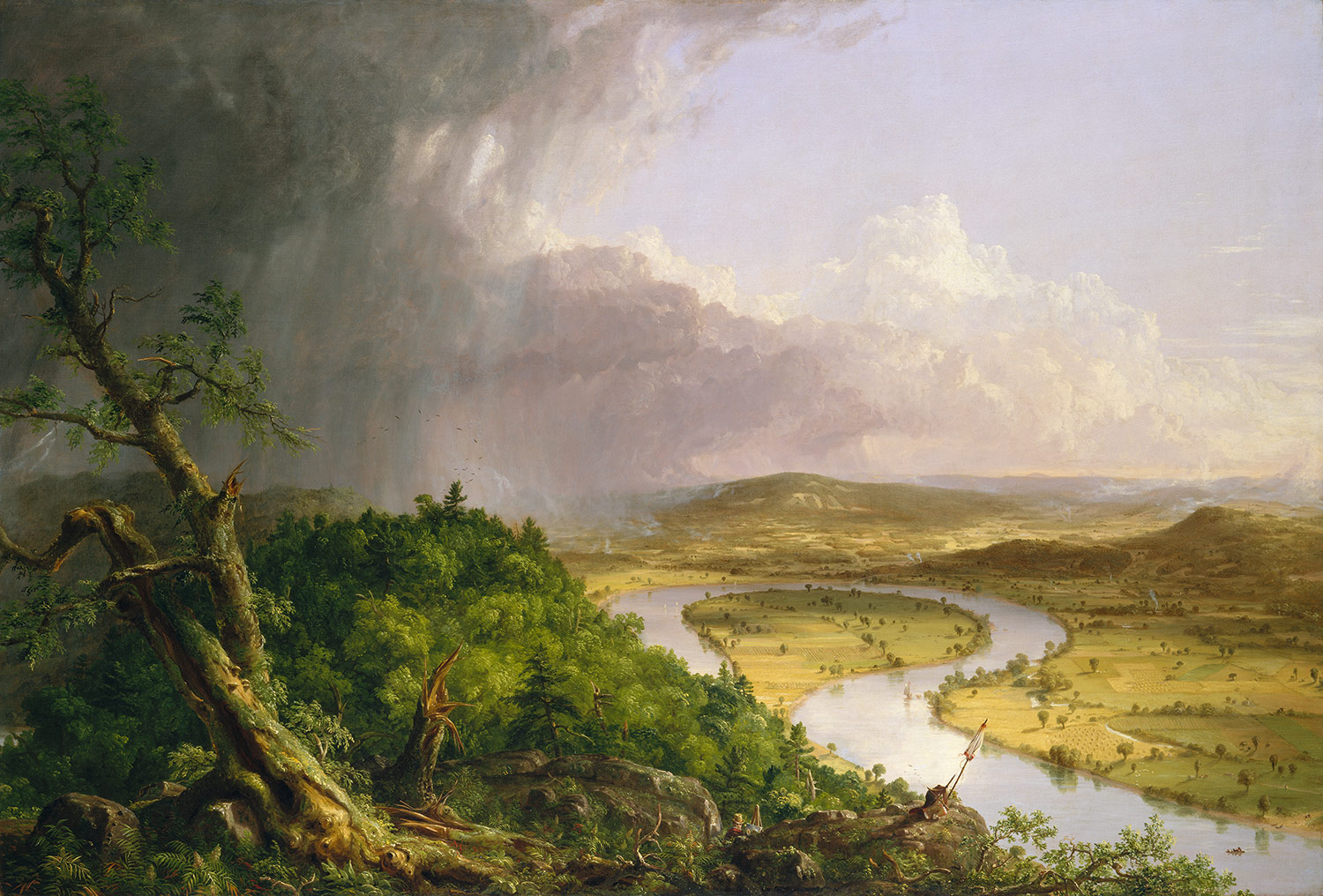 |
| Thomas Cole's "Oxbow" |
The "sublime" image in "Oxbow" is the massive, captivating scene from Mount Holyoke to the farmland below. On the left, the approaching storm clouds embody and almost omnipotent perspective. The right represents the world of man, the "better" side because it is more peaceful and familiar to the audience. The broken tree stump in the foreground represents a connection between the two halves. Cole called it "memento mori" or reminder that life is not permanent and that only Nature and the Divine are eternal. It was through pieces such as "Oxbow" that Thomas Cole illustrated his belief in the connection between beauty and good. Cole believed that the beautiful landscapes of America represented the opportunity the country had.
Alexis de Tocqueville expressed views opposite of Thomas Cole in Democracy in America. Tocqueville believed that natural landscape did not/would not play an important role in the American cultural consciousness and other forces such as religion and the legal system would play a larger role. Tocqueville also believed that American's were more concerned with subduing nature tahtn perserving it, that the focus was more geared towards technology and expansion rather than conservation.
The opposing viewpoint of Cole and Tocqueville represent the continuous debate over American attitudes towards nature. The jury is still out concerning whether or not American society values its unique landscapes. On one hand, America has a multitude of national parks and works towards conservation. On the other hand, American capitalism has quickly consumed many natural landscapes and our increasingly polluted environment is evidence of indifference.
So, if we side with pessimism Tocqueville once again serves as a forecast of America's future. I'm curious as to what my classmates will think. Which is more correct, Cole's idealistic view or Tocqueville's prediction of neglect towards nature?
Ole Spring Relief 6
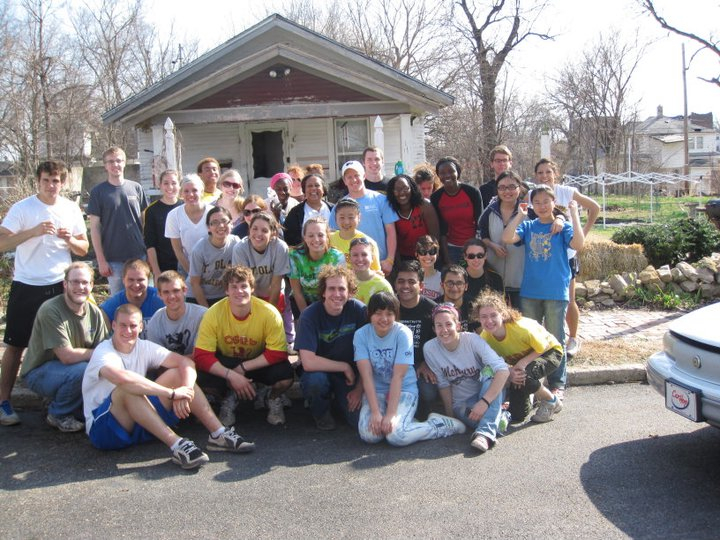 |
| Go bus 2! (Our group at a service site in Kansas City, Missouri.) |
With Tocqueville's Democracy in America and Putnam's "Bowling Alone", I couldn't help but think of the service trip in terms of social capital. Although I'd read about the surprising amount of voluntary associations geared towards service in urban areas, I was still surprised by the structure of the community and its dedicated inhabitants. For example, the city of St. Louis is in the midst of a 10 year plan to end homelessness and we worked with a shelter called Gateway 180 that is striving to do just that.
Before Ole Spring Relief, I felt cynical about the state of social capital and the power of voluntary associations in the United States. I now have a renewed hope and respect for groups that are working hard to better our society. While I'm not 100% sure of what I want to do with my life, I know for certain that I want to continue to serve by the sides of people I met, and work to support and grow our vital voluntary associations.
Subscribe to:
Posts (Atom)